I’m always intrigued when I discover a painter who isn’t that famous, but who left a definitive mark on the world of art.
Dutch painter Pieter Aertsen (1508-1575) definitely falls into this category.
Not only did he produce paintings that were well ahead of his time, but he also invented a completely new sub-genre.
His large works are usually a combination of still lifes, genre painting, and Biblical scenes that often play out in the background.
Additionally, he was painting peasants similarly to what you can admire in Pieter Bruegel’s paintings several years before the famous Flemish painter completed his.
Needless to say, “Lange Piet” or “Tall Pete” was a highly influential painter in the Low Countries and well beyond there as well.
In this article, you’ll discover 10 of Pieter Aertsen’s most notable paintings.
1. A Meat Stall with the Holy Family Giving Alms
- Date created: 1551
- Dimensions: 115.6 x 168.9 centimeters (45.5 x 66.4 inches)
- Location: North Carolina Museum of Art, Raleigh, United States
A Meat Stall with the Holy Family Giving Alms is exactly the type of painting I discussed in the introduction.
As you can see, it features a large number of seemingly unimportant elements in the foreground, in this case, the meat of a traditional meat stall of the 16th century, and several things are going on in the background.
In the middle window, you can see the Holy Family donating to the poor. This is contrasted by the indulgence going on in the tavern on the right.
These are just a few of the numerous symbols that are featured in this distinctive work of art.

I have made a video about this particular painting on my YouTube channel Art-Facts-Videos, in which I go over all of the hidden meanings and symbolism.
2. The Egg Dance
- Date created: 1552
- Dimensions: 84 x 172 centimeters (33 x 67.7 inches)
- Location: Rijksmuseum, Amsterdam, Netherlands
The Egg Dance is a painting that depicts a traditional feast that was held around Easter, namely an egg dance.
The goal was to dance among the eggs on the ground and break as few as possible. These were symbols of the rebirth of man, a tradition adopted by the Early Christians.
It’s a rather jolly scene, that, as with most of Pieter Aertsen’s paintings, has a deeper religious undertone.

3. Peasants by the Hearth
- Date created: 1560
- Dimensions: 142.3 x 198 centimeters (56 x 77.9 inches)
- Location: Museum Mayer van den Bergh, Antwerp, Belgium
Peasants by the Hearth is one of the best examples of Aertsen’s depiction of peasants, a common genre painting in the Low Countries during the 16th and 17th centuries.
Although we best know the peasant scenes by Aertsen’s contemporary Pieter Bruegel the Elder (1525-1569), he painted several of these scenes years before Bruegel picked up oil painting.
In my opinion, these people look less like caricatures than in Bruegel’s work, and this adds a layer of dignity to them.

4. The Cook
- Date created: 1559
- Dimensions: 171 x 85 centimeters (67.3 x 33.4 inches)
- Location: Musei di Strada Nuova, Genoa, Italy
The Cook is the title of a fascinating painting by Aertsen, and that’s because of two main reasons.
First of all, there doesn’t seem to be an overly religious subject matter to this work. A woman is preparing food to be cooked, that’s it.
However, contemporary viewers would have recognized her as Martha, the figure of the Biblical story, who prepares food for Jesus while her sister Mary listens to every word he speaks.
Secondly, it’s also a so-called “voluptas carnis” painting. These were warning paintings not to indulge in the pleasures of the flesh. I think the gestures speak for themselves…

5. Market Scene
- Date created: 1569
- Dimensions: 83.5 x 169.5 centimeters (32.87 x 66.73 inches)
- Location: Hallwyl Museum, Stockholm, Sweden
Market Scene is the title of a very similar painting to the first one I discussed in this list of paintings by Pieter Aertsen, but with a distinctive twist.
Instead of a meat stall, this one features fruits and vegetables, a favorite subject of Aertsen.
The realistic depiction of the cabbages and carrots must have stunned everybody who laid eyes upon this enthralling work of art in the 16th century.

. Christ in the House of Martha and Mary
- Date created: 1553
- Dimensions: 126 x 200 centimeters (49.6 x 78.7 inches)
- Location: Museum Boijmans Van Beuningen, Rotterdam, Netherlands
Christ in the House of Martha and Mary is another stunning painting that highlights just how talented Pieter Aertsen really was.
Just look at how many objects he squeezed into the foreground, while simultaneously letting several scenes play out in the background.
I find it one of his ultimate masterpieces, and as usual, for some reason, the religious subject matter was moved to the background.

7. Market with Christ and the Woman Taken in Adultery
- Date created: 1559
- Dimensions: 122.5 x 180.5 centimeters (48.2 x 71 inches)
- Location: Städel Museum, Frankfurt am Main, Germany
Market with Christ and the Woman Taken in Adultery is the title of another painting that warns viewers about the dangers of lust, one of the Seven Deadly Sins.
The Adulteress stands in the middle background, but that doesn’t stop some of the market women in the foreground from gazing at the viewers with lustful eyes.

8. The Fat Kitchen, An Allegory
- Date created: 1565-1575
- Dimensions: 110.5 x 213 centimeters (43.5 x 83.8 inches)
- Location: National Gallery of Denmark, Copenhagen, Denmark
The Fat Kitchen, an Allegory, is the title of a genre painting that features an abundant scene in the painter’s native Antwerp.
Antwerp was the commercial center of the Netherlands at the time, and scenes like this can also be considered an allegory of the growth of the city.

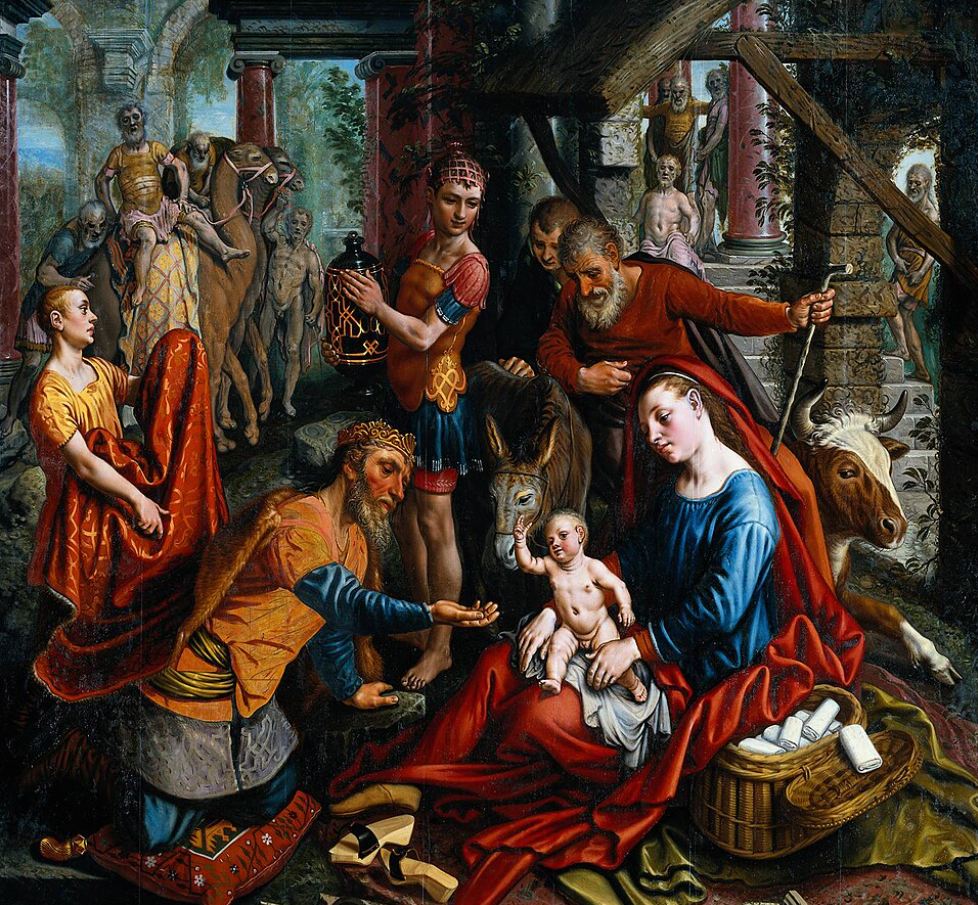
9. The Adoration of the Magi
- Date created: 1560
- Dimensions: 167.5 x 180 centimeters (65.9 x 70.8 inches)
- Location: Rijksmuseum, Amsterdam, Netherlands
The Adoration of the Magi was a popular subject in Western art. It’s one of the few overtly religious paintings by Aertsen that have survived the iconoclastic riots of the 16th century.
When I say survived, I was referring to the central panel, because this was once a triptych altarpiece that decorated a local church.
Here we can only see the oldest of the three kings. The other two were featured on the side panels, but these were unfortunately destroyed.
10. Deeds of Christian Charity
- Date created: 1575
- Dimensions: 112 x 143.5 centimeters (44 x 56.4 in)
- Location: National Museum in Warsaw, Poland
Deeds of Christian Charity is perhaps the best painting by Pieter Aertsen to conclude this list, and that’s not only because it was completed just before his death.
It embodies the hectic atmosphere that defines Aertsen’s work, and as always, the religious undertone is hidden in plain sight.