When Swiss-German Symbolist painter Arnold Böcklin (1827–1901) picked up his brushes to paint an ancient populated by ghostly figures, he wasn’t simply painting a landscape.
He was constructing an entire mood. A sacred, timeless world balanced on the knife-edge between the living and the dead.
The Sacred Grove, one of Böcklin’s most celebrated and discussed works, remains one of the most atmospheric and intellectually rich paintings to emerge from the 19th century.
Böcklin was never an artist content to paint what he could see. He painted what he could. the dread of silence and the peculiar beauty of mortality.
His career placed him at the very heart of the Symbolist movement, even as he resisted easy categorization. The Sacred Grove is perhaps the clearest window into that restless, visionary mind.
Let’s take a closer look at eight of the most fascinating facts about The Sacred Grove by Arnold Böcklin, a painting that continues to captivate art historians, mythology enthusiasts, and casual gallery visitors alike.
1. It Was Inspired by Böcklin’s Lifelong Obsession with Classical Antiquity
Arnold Böcklin was born on October 16, 1827, in Basel, Switzerland, and from an early age, he was drawn not to the modern world around him but to the ancient one.
He trained in Düsseldorf before traveling extensively through Italy, a journey that proved transformative. Rome, in particular, left an indelible mark on him.
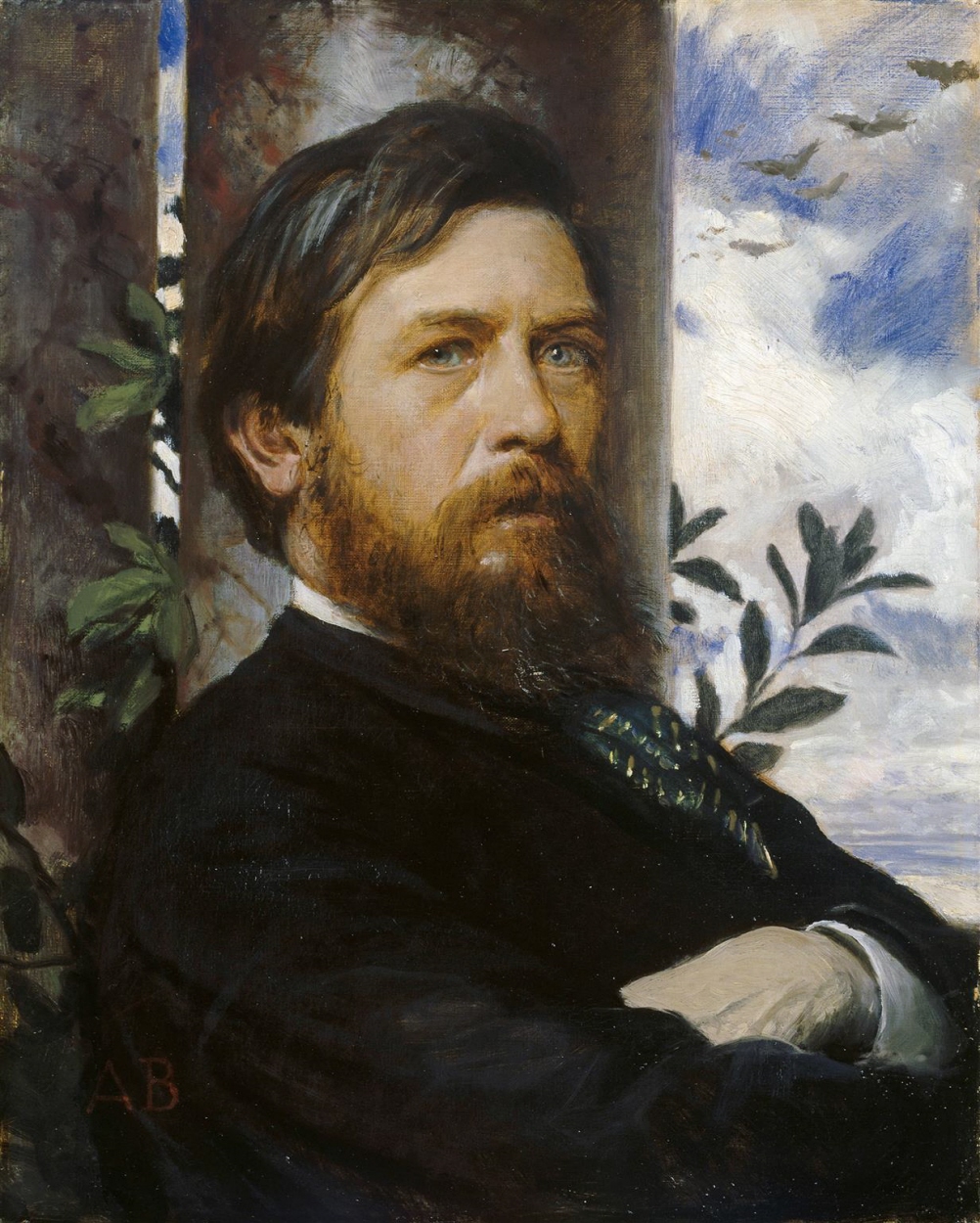
He was captivated by the ruins, the mythology, and the sense that the ancient world was not entirely gone.
This obsession with classical antiquity is what gave The Sacred Grove its distinctive atmosphere. Böcklin didn’t depict ancient Greece or Rome as historians might reconstruct it.
He depicted it as a living, breathing, almost supernatural presence. The grove itself is dense, dark, and impenetrable. It is less a forest than a threshold, the kind of place the ancient Romans called a lucus, a sacred woodland inhabited by divine spirits.

2. The Painting Was Produced During One of the Most Productive Periods of His Career
Böcklin painted The Sacred Grove in 1882, a period during which he was living and working in Florence, Italy.
By this point in his life, he was already a celebrated figure in German-speaking Europe, known for his dramatic mythological compositions and his deeply personal approach to symbolism.
The early 1880s represented the full flowering of his mature style. His particular style is defined by brooding color palettes, eerie silence, and figures drawn from Greek and Roman mythology.
It was during this same extraordinarily fertile period that Böcklin produced the various versions of his most famous work, Isle of the Dead, the first of which he completed in 1880.
The Sacred Grove can be understood as a companion piece to that iconic image. Both works share the same preoccupation with stillness, ritual, and the uneasy border between the sacred and the mortal.

3. The Grove Itself Is the True Subject of the Painting
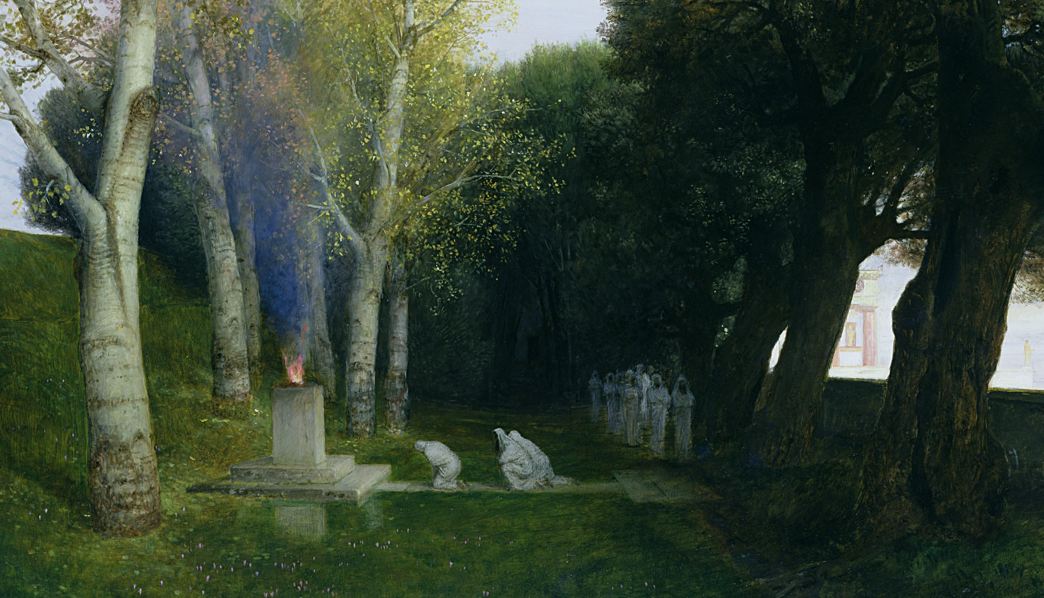
At first glance, the human figures scattered across the composition appear to be the subject of The Sacred Grove. When we look longer, however, it becomes clear that the grove itself is the real protagonist.
The ancient trees dominate the canvas with a profound presence. The light filtering through the canopy is cold and diffuse, the kind of light that belongs to neither day nor night.
This compositional choice was intentional. Böcklin understood the ancient concept of the sacred grove as a place where the divine literally resided within nature.
In Roman religious tradition, a lucus was not merely a forest. It was a living sanctuary, and to enter one without the proper rites was considered an act of profound transgression.
By making the trees the dominant force in the painting, Böcklin communicates this sense of awe and danger more powerfully than any mythological figure ever could.
The human figures are dwarfed by the trees. They are visitors, not inhabitants. Their rituals seem almost irrelevant against the ancient indifference of the grove.

4. The Figures Are Drawn Directly from Classical Mythology and Ritual
The robed figures moving through the sacred space are painted with an almost theatrical solemnity.
Several carry offerings or appear to be engaged in ritual processions. These behaviors are consistent with the religious practices of ancient Greece and Rome.
Böcklin drew heavily on his deep reading of classical sources, and the figures in The Sacred Grove reflect a genuine understanding of antique ritual life rather than a superficial borrowing of costumes and props.
Some art historians have noted similarities between the figures in The Sacred Grove and those depicted in the Panathenaic procession on the frieze of the Parthenon, which Böcklin would have known through casts and engravings.
Others have pointed to the Eleusinian Mysteries. These were the secret initiation rites held at Eleusis in ancient Greece.
This grounding in genuine classical scholarship is part of what separates Böcklin from mere fantasy painters. His mythological worlds feel inhabited and real because he built them on solid historical and literary foundations.

5. It Reflects the Broader Symbolist Movement Sweeping European Art
By the 1880s, a powerful reaction against Realism and Impressionism was taking shape across European culture.
Where the Impressionists celebrated the fleeting, the sensory, and the contemporary, the Symbolists turned inward
Böcklin was a central figure in this shift, and The Sacred Grove is one of the movement’s defining images.
The Belgian poet and playwright Maurice Maeterlinck, the French painter Gustave Moreau, and the German composer Richard Wagner were all, in their different ways, engaged in the same project as Böcklin: the recovery of myth as a living spiritual and emotional force in a rapidly industrializing world.
The Sacred Grove belongs to this broader cultural conversation. It is, in essence, a protest against modernity and a declaration that the ancient, the sacred, and the mysterious still have a claim on the human soul.

6. Böcklin Painted Multiple Versions of the Composition
Like many of his most important compositions, Böcklin did not paint The Sacred Grove only once.
He returned to the subject multiple times throughout his career, refining the composition, adjusting the palette, and subtly shifting the emotional register of the work.
This was a characteristic practice for Böcklin. His five versions of Isle of the Dead are the most famous example, but The Sacred Grove similarly exists in multiple iterations.
This repeated return to the same subject was not a sign of indecision but of obsession.
Böcklin was attempting, with each new version, to get closer to an essential feeling that he believed the composition could express.
7. The Painting Had a Profound Influence on Later Artists and Thinkers
The reach of Böcklin’s Sacred Grove extended far beyond the walls of any single gallery.
The philosopher Friedrich Nietzsche, who was developing his own deeply mythological philosophy during the same decades Böcklin was at his peak, was a passionate admirer of the Swiss painter’s work.
The overlap between Nietzsche’s celebration of Dionysian irrationality and Böcklin’s myth-saturated paintings is striking and almost certainly not coincidental.
In the visual arts, Böcklin’s influence can be traced through the work of the early Surrealists, particularly Giorgio de Chirico (1888–1978), whose haunted piazzas and metaphysical cityscapes owe a profound debt to the atmosphere Böcklin created in paintings like The Sacred Grove.
De Chirico himself acknowledged this debt explicitly, naming Böcklin as one of the key artists who showed him how a painted space could be psychologically charged and emotionally overwhelming.

8. Where Can You See The Sacred Grove Today?
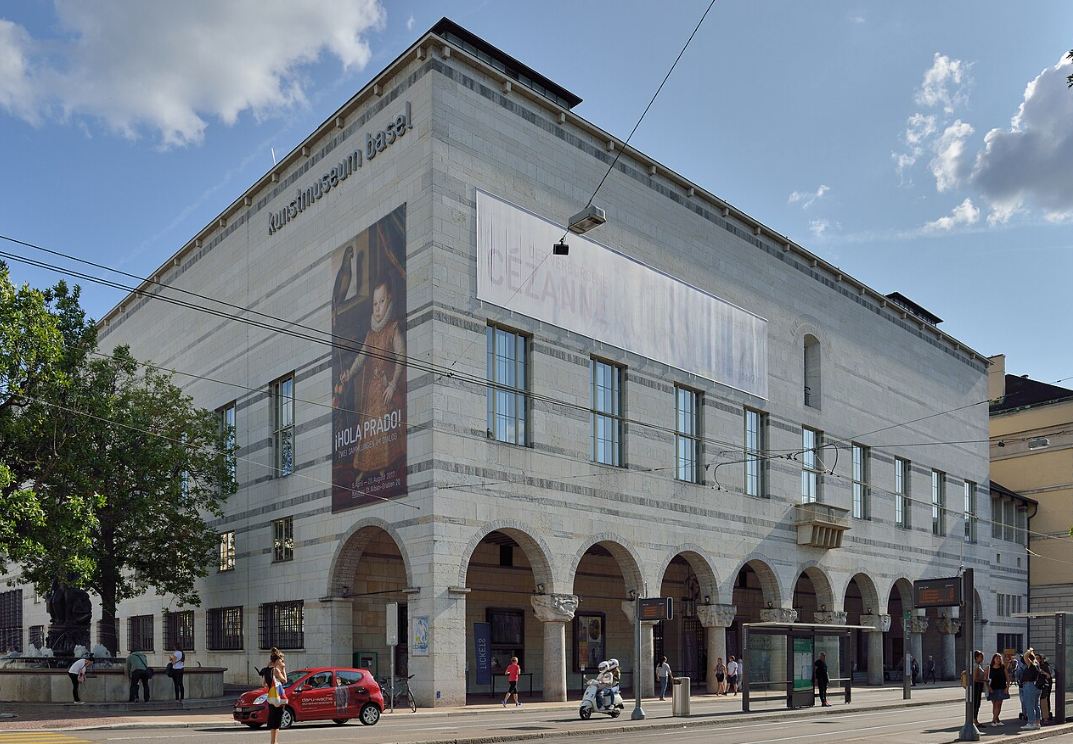
The most celebrated version of The Sacred Grove is housed in the Kunstmuseum Basel in Switzerland. I find it a fitting home for a painting by Basel’s most famous artistic son.
The Kunstmuseum Basel holds one of the most important collections of Böcklin’s work in the world, and seeing The Sacred Grove in person, in the city where Böcklin was born and where he first developed his artistic ambitions, gives the painting an additional layer of resonance.
Other versions and related works by Böcklin can be found across Europe, including at the Nationalgalerie in Berlin and the Kunsthaus Zürich.
The Sacred Grove is far more than a beautiful painting about ancient trees and robed figures.
It is an invitation to step across a threshold, into a world where nature is sacred, silence is meaningful, and the past is never entirely past.